This feels uncomfortable at first. You worry people will think you're unresponsive. But most messages don't need an immediate reply. And when you respond thoughtfully twice a day instead of reactively all day, the quality of your communication actually improves.
If your team has a real emergency channel (production is down, a client is blocked), that's different. Keep a separate channel for that and monitor it. Everything else can wait 2 hours.
3. The daily shutdown ritual
One of the most underrated time management habits for developers is how you end your day.
Most developers stop working when they run out of energy, close their laptop, and start fresh the next morning trying to remember where they left off. That cold start costs 20 to 30 minutes every single day.
The daily shutdown ritual fixes this.
Before you close your laptop, spend 10 minutes doing three things:
First, write down exactly where you are on your current task. Not a vague note like "working on auth." Something specific: "JWT token validation is working, failing on refresh token expiry edge case, next step is to check the token TTL logic in auth.service.ts line 142."
Or if you're on frontend work: "Dropdown component renders correctly on desktop, but the z-index is breaking on mobile Safari, next step is to check the stacking context on the parent container."
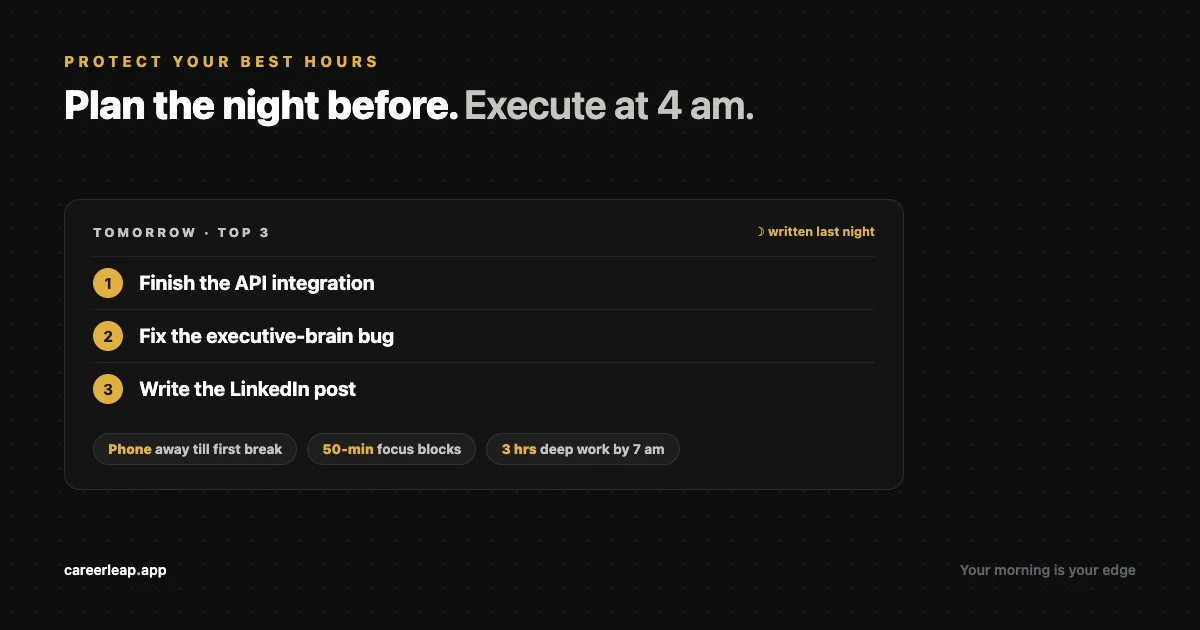
Second, write your top 3 priorities for tomorrow. Not a full to-do list. Just the three things that matter most. This becomes your starting point in the morning.
Third, close everything. Tabs, terminals, Slack. A clean workspace tomorrow means you start with intention instead of picking up whatever was left open.
This ritual takes 10 minutes. It saves 30. And it means you can actually disconnect in the evening because your brain isn't trying to hold the context of unfinished work.
4. Handling interruptions without destroying flow
Even with good time blocking, interruptions happen. A colleague walks over. Someone drops a question in your DM. You're in the middle of a complex function and your brain suddenly surfaces an unrelated idea you don't want to lose.
The parking lot method handles all of these without breaking your flow.
Keep a simple text file or physical notebook open at all times called "parking lot." When an interruption happens or an idea surfaces, you have two options:
If it's a request from someone else: write it down in the parking lot with enough context to handle it later, then tell the person "I'll get back to you by end of day" or "I'll look at this after 12pm." Then return to your work immediately.
If it's your own idea or a tangent your brain wants to chase: write it in the parking lot and keep moving. The act of writing it down signals to your brain that it won't be forgotten, which is usually why your brain keeps surfacing it.
For example, a good parking lot entry looks like this: "Check if we're using bcrypt or argon2 for password hashing in the auth service." That's enough context to handle it later without losing your current thread.
Review the parking lot twice a day during your async windows. Most items either resolve themselves, turn out to be less urgent than they felt, or take 5 minutes to handle.
The parking lot works because it separates capture from action. You don't have to decide right now whether something is important. You just have to make sure it doesn't disappear.
5. Saying no to low-value tasks
Every developer has a list of things they do regularly that don't actually require their skills. Attending meetings where they're not needed. Writing status updates that nobody reads. Reviewing code that a junior dev could handle with a checklist.
Saying no to these things is a time management skill. But most developers avoid it because they don't want to seem unhelpful or difficult.
Here's a framework that works.
Before agreeing to any recurring commitment, ask: "What happens if I don't do this?" If the honest answer is "not much," that's a signal.
For meetings: ask for an agenda before accepting. If there's no agenda, ask what decision needs to be made and whether your presence is required to make it. Often it isn't.
For tasks that could be delegated: do it once, document the process, then hand it off. This takes more time upfront but frees you permanently.
For requests that are genuinely low priority: be direct but offer an alternative. "I can't get to this this week, but if it's still needed next week I can look at it then" is honest and leaves the door open.
The goal is not to be the developer who says no to everything. It's to be the developer who protects their deep work time so that when they say yes, they can actually deliver.
Takeaways
- The problem is context-switching, not laziness or poor discipline.
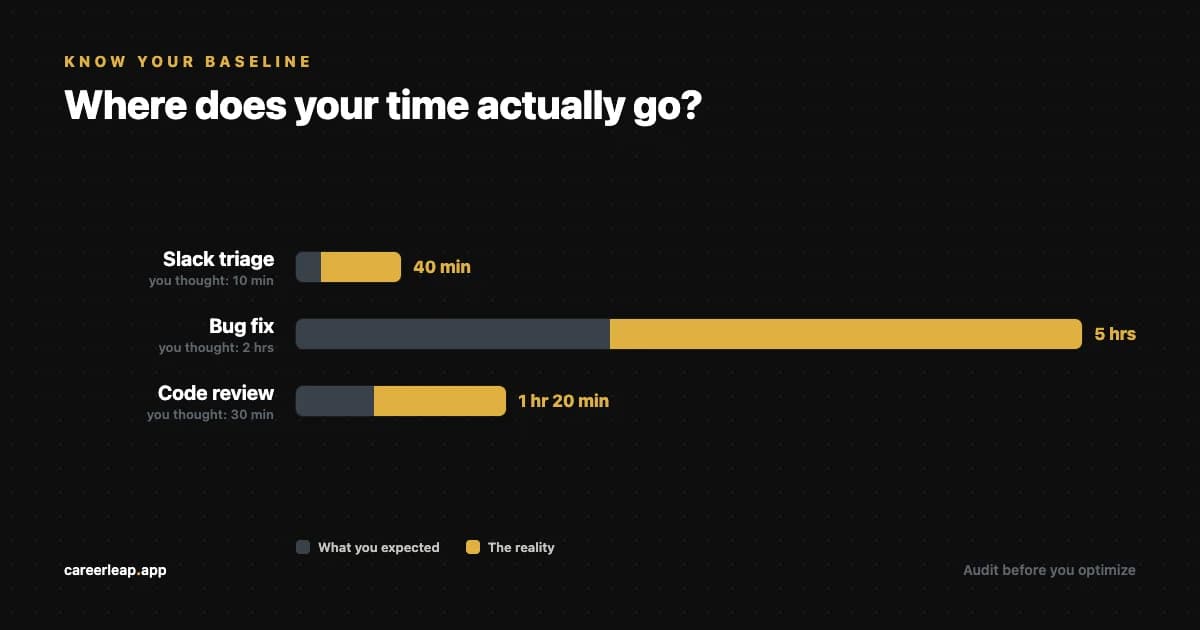
- Every interruption costs 23 minutes of recovery time, not 30 seconds.
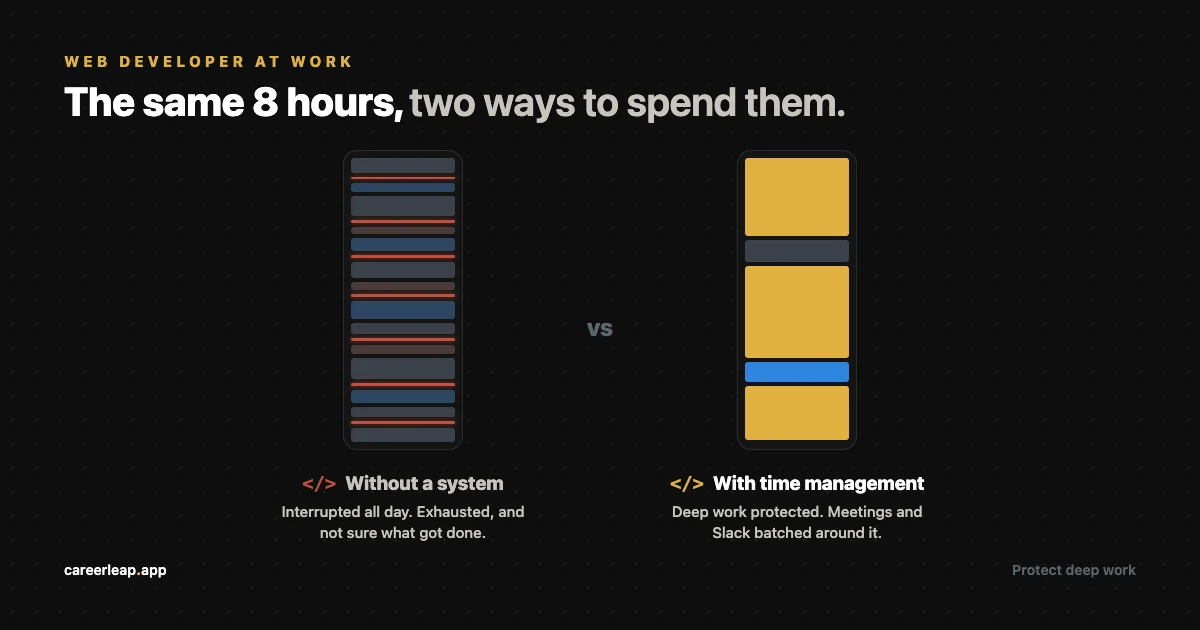
- Protect your peak hours first. Build everything else around them.
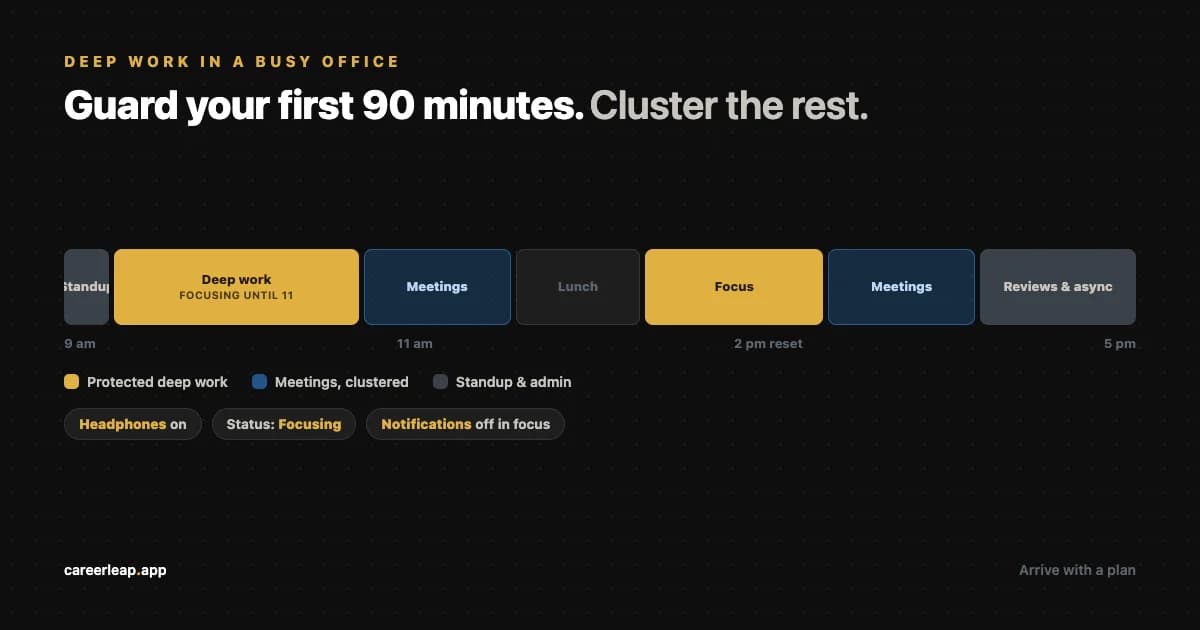
- Batch your meetings into 1 to 2 windows per day.
- Respond to Slack and email twice a day, not constantly.
- End every day with a shutdown ritual. Start tomorrow with a plan, not a blank screen.
- Use a parking lot to capture interruptions without losing flow.
- Say no to low-value commitments. Protect your time so your yes actually means something.
Pick one of these five tactics and start Monday. Just one.
Every week I send one practical tip to help you grow faster as a developer. No fluff, just what works. Join the newsletter.