I used to check WhatsApp first thing every morning.
Post stats. Video stats. Comments. DMs.
Some days it pulled me into responding to messages. Other days I'd end up watching other people's content. Either way, I'd look up and 30 to 90 minutes had disappeared.
That was my most productive window. Gone before I wrote a single line of code.
So I stopped. Now my phone stays away until my first break.
Your morning is decided the night before
Most developers plan their day in the morning. That's already too late.
By the time you sit down, check your calendar, figure out what matters, and decide where to start, you've burned 20 minutes of your sharpest mental energy on decisions instead of work.
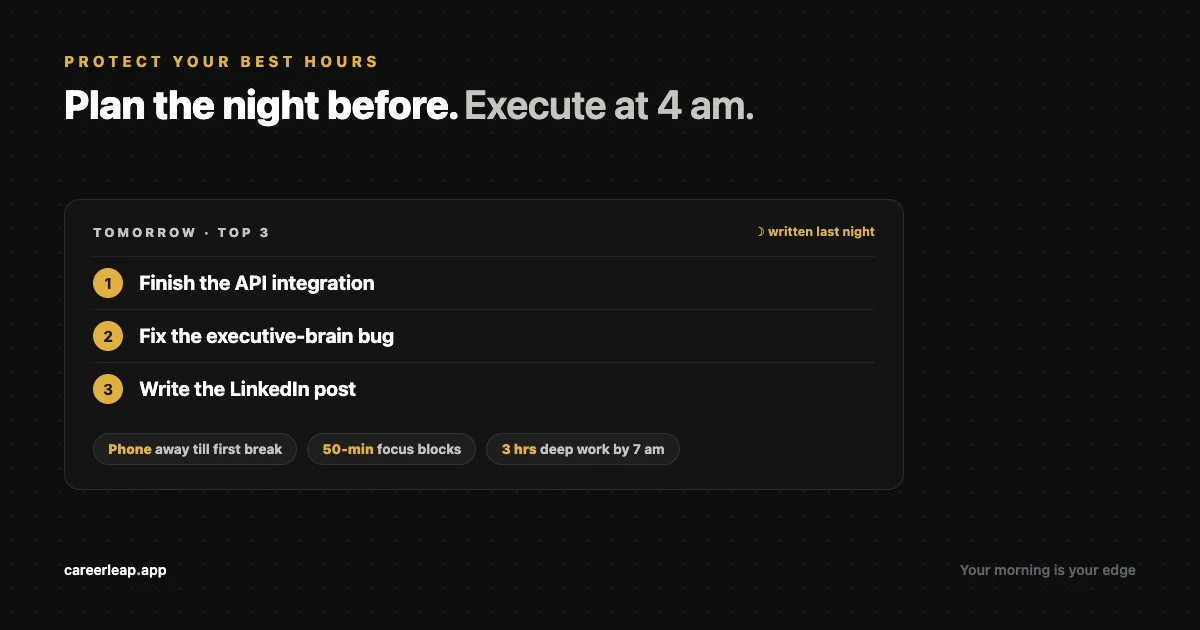
The night before, before going to bed, I make a list of the next day's priorities. I also write down what I accomplished that day. It's a quick 5-minute reflection.
By morning, the decision is already made. I just execute.
My actual routine
I wake up at 4am. Two glasses of water. No tea yet, no phone. I open the first item I decided on the night before and set a 50-minute timer.
Not 25 minutes. Fifty.
The standard Pomodoro is 25 minutes, but 25 minutes is barely enough time to load a complex problem into your head. By the time you're in flow, the timer goes off. I use a physical Pomodoro timer with 50-minute blocks. It took a few weeks to build up to it, but now it's the only way I work.
After 50 minutes, I make tea. That's when I check WhatsApp: usually a message from my co-founder Virgil. I respond, then get back to work.
Around 6am, second break. I go for a walk in my community. During the walk, I check my messages, talk to Akash, my virtual assistant or Virgil, my business partner. And some days, just the walk.
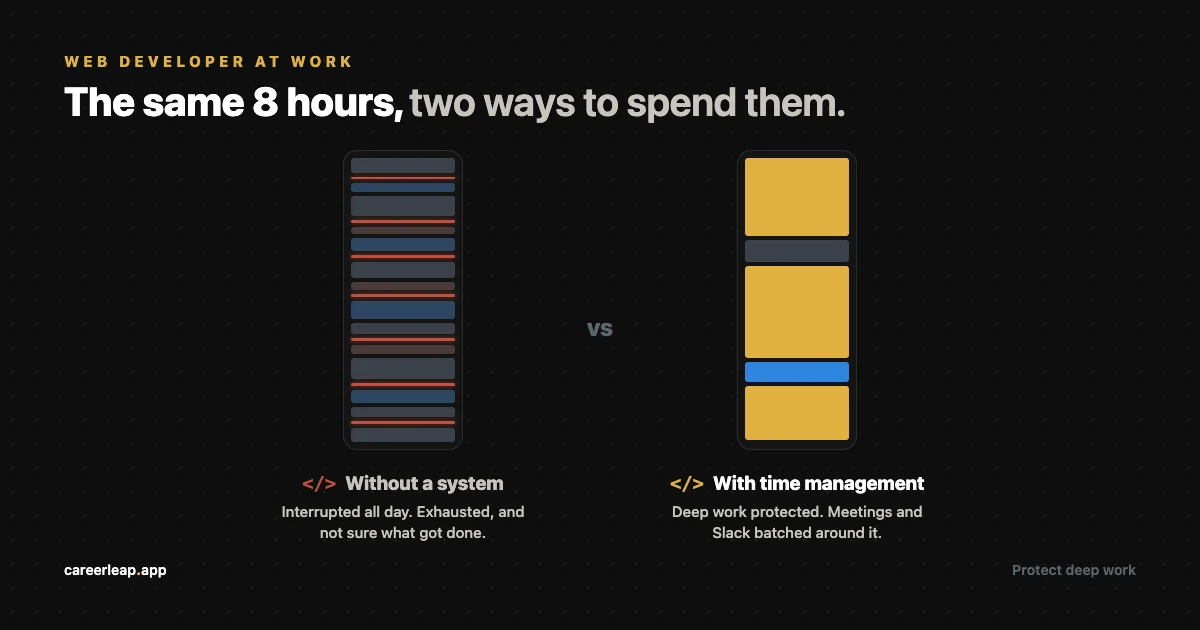
By 7am, I've done three hours of uninterrupted deep work. Most developers get maybe two hours of actual focus time in an entire eight-hour workday.
The top 3 rule
I never plan more than 3 priority tasks for a day.
I make a list of everything in my head and brain-dump it on a page. Then circle the top 3 things. Just the 2 or 3 things that actually matter the most today. Those things set the focus and intention for the day. If I finish all three, everything else is a bonus.
On a typical day my top 3 might look like: finish the API integration for the product experience engine, fix the bug in the executive brain, and write the LinkedIn post. Everything else- messages, admin, random requests- waits until those three are done or scheduled.
The top 3 list also helps you with interruptions and conflicting priorities. You can compare them and see if they are more crucial than what you already planned. Almost always the answer is no. You stay on track without having to pivot.
Most developers lose their day here. They start without a top 3, so every interruption feels equally valid.
Once you have your top 3, put them on your calendar with a specific time block. A task without a time block is just a wish.
Distraction blocking that actually works
A few things that make the routine stick:
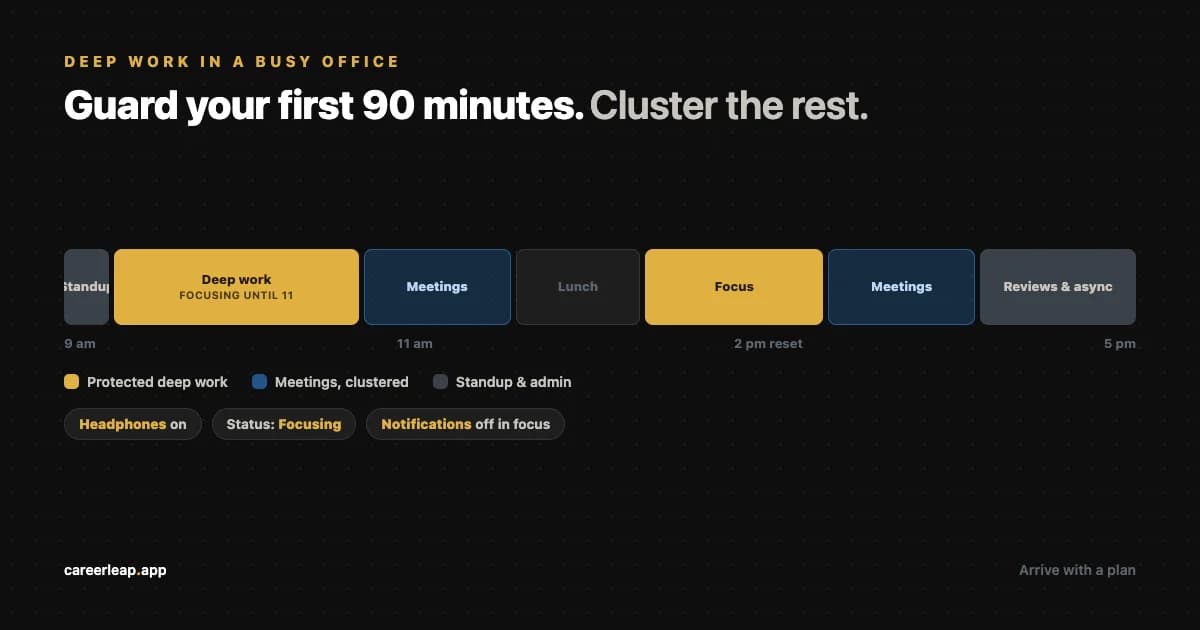
- Phone away until the first break. Not on silent. Away. Silent still lets the screen light up. Out of sight means out of mind.
- Noise-canceling headphones during deep work. They signal to everyone around you, and to yourself, that you're unavailable.
- Notifications off on both phone and computer during focus hours. Apple focus mode really helps for this. Every notification is a decision: do I respond now or later? Remove the trigger and you remove the decision.
- Family knows to call twice if it's urgent. One call means it can wait.
None of this is rocket science. The hard part is protecting your first few hours from whoever messaged you overnight.
Takeaways
- Plan the night before. By morning, just execute.
- Pick 2 to 3 priority tasks. Finish those. Everything else is a bonus.
- Schedule your top tasks on the calendar. A task without a time is a wish.
- Keep the phone away until your first break. Your best hours are not for reactive mode.
- Use longer Pomodoro blocks. 50 minutes beats 25 for deep coding work.
- Know your top 3 and every interruption becomes easy to evaluate.
- Your morning routine is your competitive advantage. Protect it like your code depends on it.
Every week I send one practical tip to help you grow faster as a developer. No fluff, just what works. Join the newsletter.