You arrive at the office with a plan.
Then Slack lights up. Someone has a quick question. The standup runs long. A bug comes in that's blocking QA.
You look up and it's 11am. You haven't touched the thing you actually came in to do.
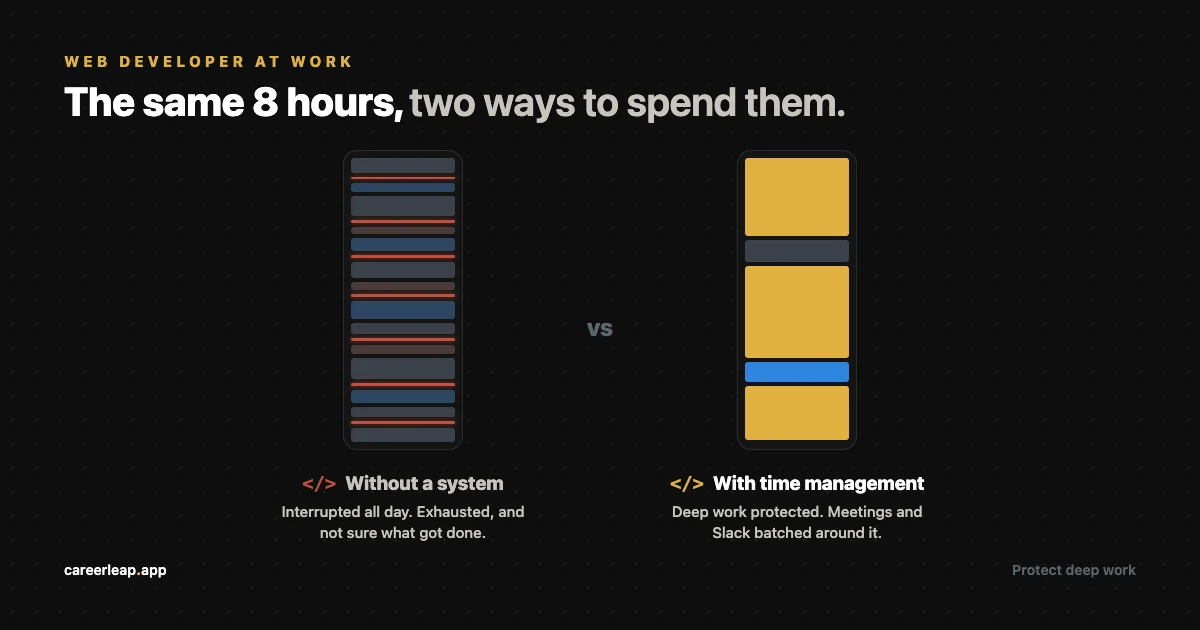
This is not a discipline problem. It's a structure problem. The office day is designed to pull your attention in every direction except the work that matters most. The office is full of developers who arrived with a plan and left having spent the day in other people's priorities.
Without a deliberate system, the day happens to you instead of the other way around.
Here's how to fix that.
Set your intention before the day starts
The biggest mistake office developers make is arriving without a clear intention for the day.
When you sit down without a plan, the path of least resistance is to open Slack, check email, and start responding. You feel productive. You're moving. But you're moving on other people's priorities, not your own.
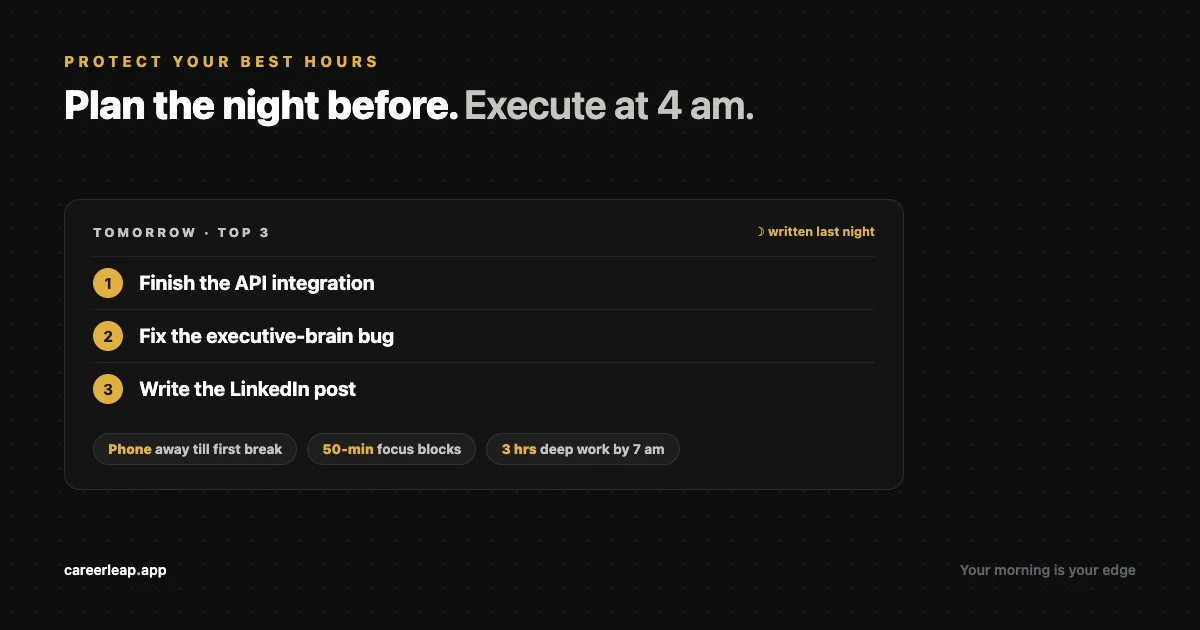
The fix is simple: decide your top 3 tasks before you arrive.
Do it the night before, or during your commute. Not a full to-do list. Just the 2 or 3 things that would make today a success if you finished them. Write them down somewhere you'll see them when you sit down.
When you arrive, your first action is to open your task list, not Slack.
The first 10 to 15 minutes matter more than most developers realize. If you spend them reacting, you've already handed the day to someone else. If you spend them setting direction, you have a reference point for every decision that follows.
Once you know what matters today, the next job is protecting enough time to actually do it.
Protect your first 90 minutes
Once you're in the office, your first 90 minutes are your most valuable. Your brain is fresh, the floor is quieter, and most colleagues haven't fully ramped up yet.
This is your deep work window. Protect it.
Here's what that looks like in practice:
- Don't open Slack until after your first focus block.
- Set your status to "Focusing" or "In deep work until 10:30am" so colleagues know you're unavailable.
- Put on noise-canceling headphones. This signals to anyone walking past that you're in the middle of something.
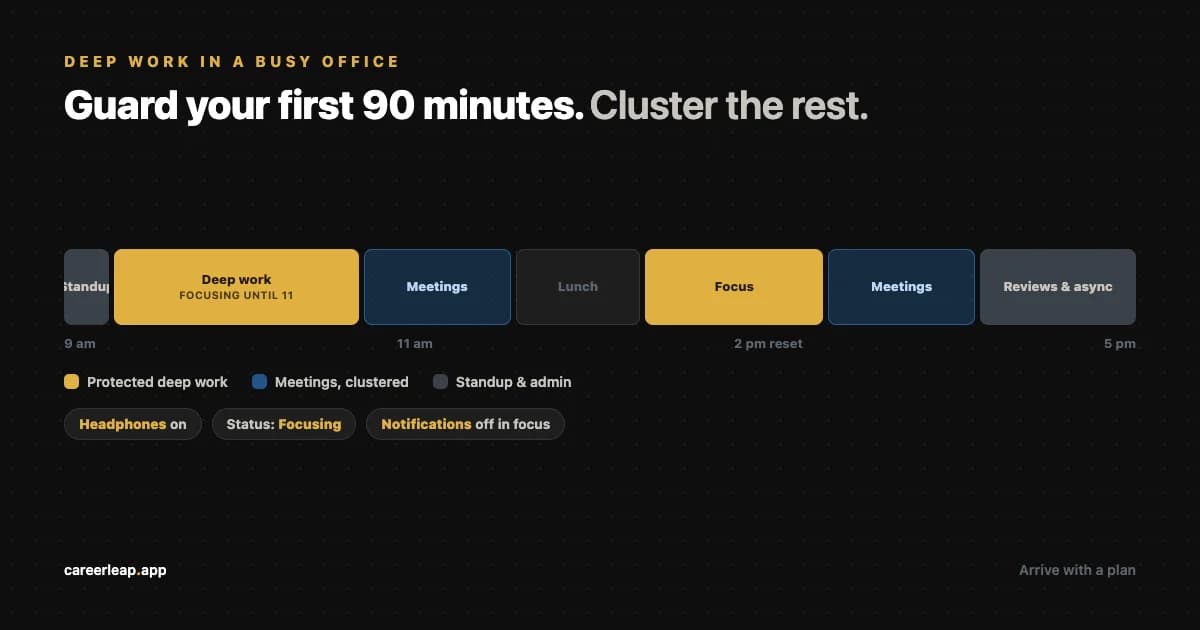
If your team has a standup at 9am, that's fine. Attend, keep it short, then go straight into your focus block immediately after. Don't let the standup bleed into a 30-minute conversation.
The goal is one uninterrupted block of 60 to 90 minutes on your most important task before the day gets noisy. Even on the busiest days, this one block can be the difference between a day where you moved something forward and a day where you just kept up.
Time blocking around meetings
Most office developers can't avoid meetings. The goal isn't to eliminate them. It's to stop letting them fragment your day into useless 20-minute gaps.
A 30-minute meeting at 10am and another at 2pm doesn't cost you one hour. It costs you the focus blocks on either side, because you can't fully commit to a complex problem when you know you have to stop in 45 minutes.
The fix is to cluster your meetings.
Push meetings to late morning (11am to 12pm) and mid-afternoon (3pm to 4pm) wherever you can. This protects your morning for deep work and your late afternoon for admin, code reviews, and async responses.
If you can't move the meetings, work around them. A 90-minute gap between meetings is a focus block. A 20-minute gap is not. Use the short gaps for email, Slack, and low-effort tasks. Save the long gaps for real work.
If your standup is at 9:30am, don't start a deep work block at 9am. You'll spend 25 minutes loading context and then have to drop it. Start at 9:45 instead and protect a full 90-minute block from there.
Distraction blocking in an open office
Open offices are hard. The environment is not designed for deep work. You have to create your own bubble.
A few things that work:
- Noise-canceling headphones are non-negotiable. They block sound and signal to colleagues that you're focused. Most people will think twice before tapping you on the shoulder when you're wearing them.
- Set your Slack status during focus blocks. "Focusing until 11am" is clear and professional. Most colleagues will respect it. For urgent things, they'll ping you anyway and you can decide whether it's worth breaking focus.
- Turn off all non-essential notifications during focus blocks. Email, Slack, Teams, phone. Check them at set times: once mid-morning and once mid-afternoon.
- Tell your team about your focus blocks once. You don't need to explain it every day. "I do my best deep work in the mornings, so I try to keep that time clear" is enough. Most reasonable teams will adapt.
The mid-day reset
Even with good planning, the office day goes sideways. A meeting runs long. An urgent bug comes in. Someone needs help with something only you can fix.
By 2pm, the original plan is often wrecked.
That's fine. Take 5 minutes and reset.
Look at your top 3 from this morning. What's done? What's still open? What's the single most important thing you can still finish before end of day? Protect one more focus block for that thing and let everything else wait.
A reset mid-day is not a failure. It's what separates developers who finish things from developers who stay busy all day and ship nothing.
Takeaways
- Decide your top 3 the night before or during your commute. Arrive with a plan.
- Spend the first 10 to 15 minutes setting direction, not reacting to Slack.
- Protect your first 90 minutes. This is your most valuable window.
- Cluster meetings into late morning and mid-afternoon. Protect the gaps in between.
- Noise-canceling headphones and a Slack status are your two most effective office tools.
- When the day goes sideways, take 5 minutes at 2pm and reset. Pick one thing to finish before you leave.
- A day where you moved one important thing forward is a good day. Most developers forget that.
Every week I send one practical tip to help you grow faster as a developer. No fluff, just what works. Join the newsletter.