Most developers think about productivity wrong. They optimize for hours worked. More hours, more output. Push through the fatigue, ship the feature, sleep when it's done.
But that's not how your brain works.
Your brain operates in cycles. High alertness, then low alertness, roughly every 90 minutes. This isn't a theory, it's physiology. Nathaniel Kleitman, the researcher who discovered REM sleep, identified these cycles decades ago. He called them the Basic Rest-Activity Cycle, or BRAC.
When you hit the low phase of that cycle and push through anyway, you're not being productive. You're grinding on a depleted engine. The code you write in that state takes longer, has more bugs, and costs you more time to fix later.
The developers who sustain high output over years don't work more hours. They manage their energy better.
What the research actually says
The Ultradian Rhythm research gives us the 90-minute window. Work with your natural alertness cycle, not against it.
The DeskTime study, run by a social networking company tracking real worker productivity, found something more specific: the most productive workers followed a pattern of 52 minutes of focused work followed by a 17-minute break. Not the Pomodoro 25/5. Longer focused blocks, longer recovery.
A 2011 study in the Journal of Cognition found that brief mental breaks during repetitive tasks helped participants maintain focus and perform better over time compared to those who worked straight through.
The consistent finding across all three: short, regular breaks improve focus, reduce errors, and sustain performance over a full workday. Working through fatigue does the opposite.
The research points to the same conclusion from different angles: your brain needs recovery time built into the workday, not bolted on at the end.
What this means for developers
Deep work, the kind that requires holding complex systems in your head, debugging subtle logic errors, designing architecture, is cognitively expensive. It depletes your mental resources faster than most jobs.
This means the 90-minute cycle hits developers harder than it hits most knowledge workers. And it means recovery isn't optional. It's part of the work.
A 30-minute break taken at the right time will recover more productive output than grinding through that same 30 minutes on a depleted brain.
My break routine
I work in focused blocks of about 50 minutes, then step away for a 10-minute break. Not always perfectly, but consistently enough that it's become a habit.
What those breaks look like depends on where I am and what I need.
At home, I'll go to my backyard garden and water the plants. There's something about being outside and doing something physical and low-stakes that resets my head in a way that scrolling never does. Sometimes I grab a snack, a banana, some pumpkin seeds, a glass of water. Small things, but they pull me out of the screen.
In an office, I'll take a two-minute walk around the floor. Or switch from sitting to standing, or standing to sitting. Sometimes I use the break to write down what I've done and what's next, which doubles as a mini shutdown ritual and a mental reset.
Occasionally I'll call my parents or a friend. Not to talk about work. Just to be a person for five minutes.
None of these are elaborate. That's the point. The break doesn't need to be a meditation session or a gym workout. It just needs to be genuinely away from the screen and the problem.
What I've noticed over time is real. Every time I take a break, I come back feeling recharged. Even five minutes of genuine disconnect gives a noticeable boost. Over months of doing this consistently, my anxiety level dropped. The low-grade burnout I used to carry around got better. My focus improved.
And breaks do something grinding never will: they let your brain keep working on the problem in the background. More than once, the fix for a bug I was stuck on arrived while I was watering the plants, not while I was staring at the screen. Stepping away isn't just recovery. It's often how the hard problem finally gets solved.
And here's the thing I didn't expect: even on days when I work four or five hours straight in total, it doesn't feel that long. Each break resets the clock mentally. You don't accumulate the same fatigue. The day feels more manageable, and the work feels less like a grind.
How to build your break routine
The mistake most developers make is treating breaks as something that happens when they run out of energy. By then it's too late. You've already been running on fumes for 30 minutes.
Schedule breaks before you need them.
Here's a starting template you can adjust to fit your day:
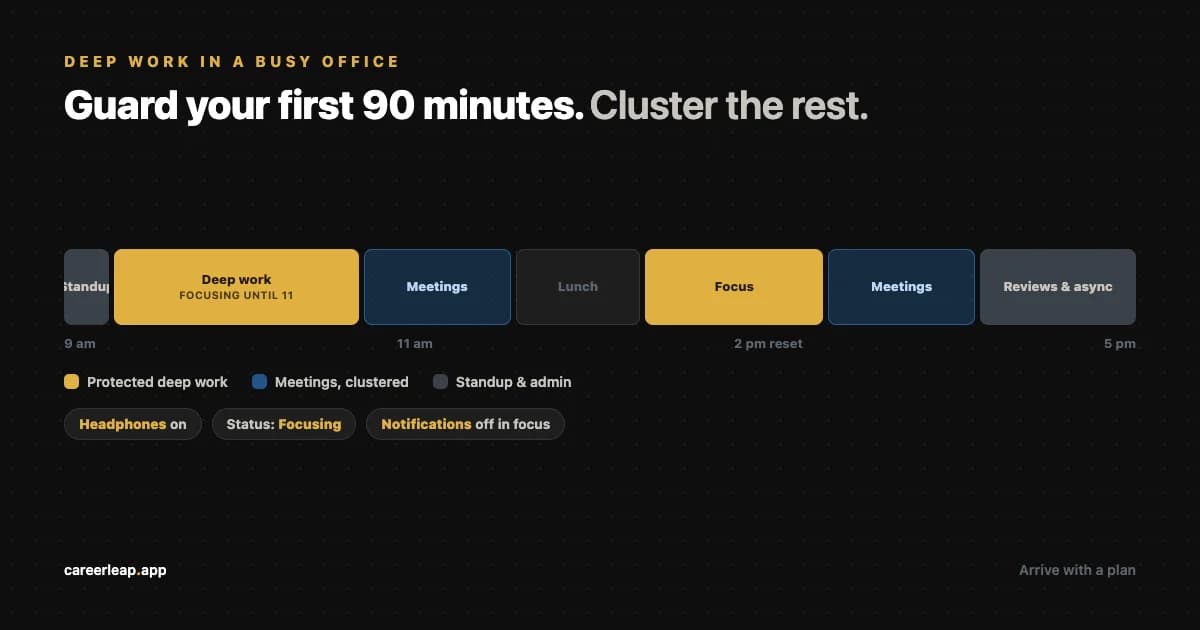
9:00am    Start deep work block
10:00am   10-minute break (walk, snack, stretch)
10:10am   Second deep work block
11:30am   Short break before meetings
12:00pm   Lunch (real break, away from desk)
1:00pm    Third deep work block or meetings
2:30pm    10-minute break (outside if possible)
4:00pm    Wrap-up, code review, async responses
5:00pm    Shutdown ritual
The specific times matter less than the structure. You want at least one break every 60 to 90 minutes during deep work periods, and at least one that gets you outside or physically moving.
A few things that help make breaks stick:
- Attach the break to something you already do. Making tea, watering plants, refilling your water bottle. Habit stacking makes it automatic.
- Set a timer. When you're deep in a problem, 90 minutes disappears. The timer is not optional.
- Protect the break the same way you protect deep work. Don't let a Slack message pull you back in before you've actually recovered.
- Use the break to log your progress. Two minutes of writing what you just did and what's next means you return to work with direction instead of having to reload context from scratch.
Takeaways
- Your brain operates in 90-minute alertness cycles. Work with them.
- A break taken at the right time recovers more output than grinding through fatigue.
- Schedule breaks before you need them, not after you've already crashed.
- The break doesn't need to be elaborate. A walk, a snack, a glass of water, two minutes outside.
- Attach breaks to existing habits so they happen automatically.
- Breaks also let your brain solve the problem in the background. The fix often arrives when you step away.
- Use part of the break to log what you did and what's next. You'll return with direction.
- Consistency over perfection. A rough break schedule followed daily beats a perfect one followed never.
Every week I send one practical tip to help you grow faster as a developer. No fluff, just what works. Join the newsletter.