I spent years trying to build a second brain.
A few years ago I joined Tiago Forte's Build a Second Brain cohort. I loved the framework. Capture. Organize. Distill. Express. Four words, one clean loop.
I built several versions for myself. I tried Notion. I tried Obsidian. I tried plain markdown in folders. I read the book twice.
None of them stuck.
The problem was never the framework. The framework is good. The problem was the maintenance.
A second brain only works if you actually keep it fed. And keeping it fed means capturing notes from calls, voice memos, rough ideas, docs, campaign data, tasks, client updates, Slack threads, emails, market signals. Every day. Forever.
That is too much for one person to organize properly. I tried. I would do it for two weeks. Then I would miss a day. Then a week. Then I would open the vault three months later and realize I had been building a museum, not a tool.
The framework was not asking too much. Life was.
Over the last two months, that changed.
What is different now
I built five AI operating systems using Claude Code and Hermes-Agent. They are not chatbots. They are not Notion templates. They are systems that actually run in the background and do the part I could never sustain.
The five so far:
Virgil Brain. The operating system for Virgil, my co-founder, and the work he does with clients.
Team Brain. The shared knowledge layer for everyone we work with.
Sucana Brain. The technical and product brain for what I am building at 4am.
Agency Brain. The operations layer for the agency side of the business.
Personal Brain. Mine. My ideas, my projects, my voice notes from the drive to Costco.
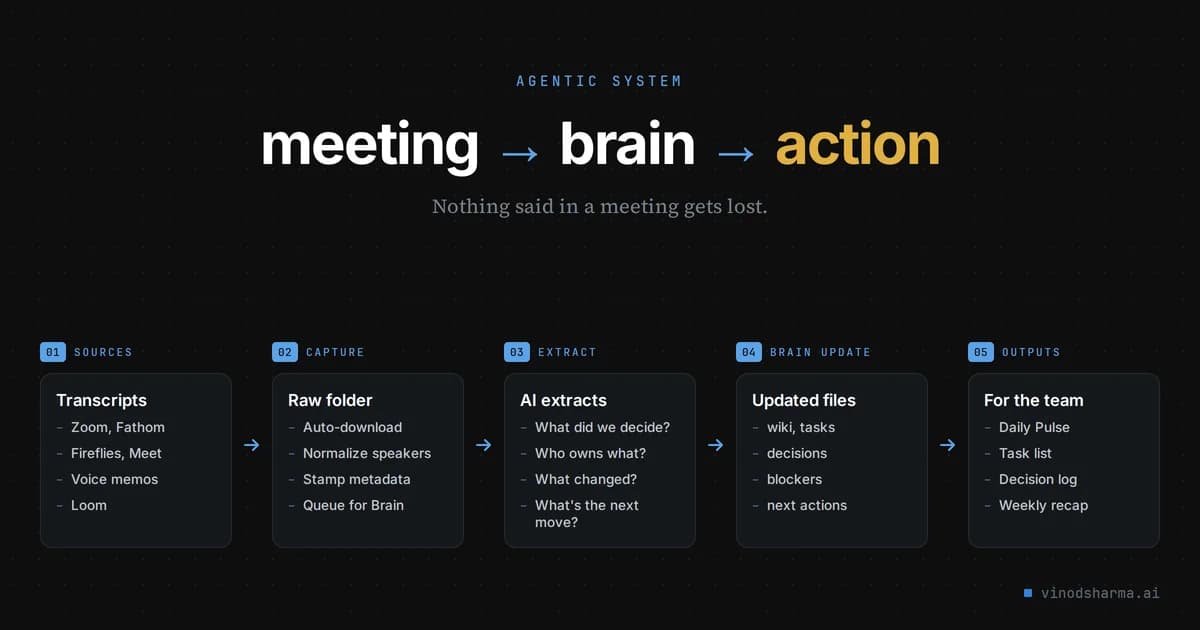
Each one has the same job. Take messy human inputs and turn them into a clean, navigable record. Each one has its own scope and its own owners. None of them depends on me remembering anything.
The newest one is the one I keep thinking about
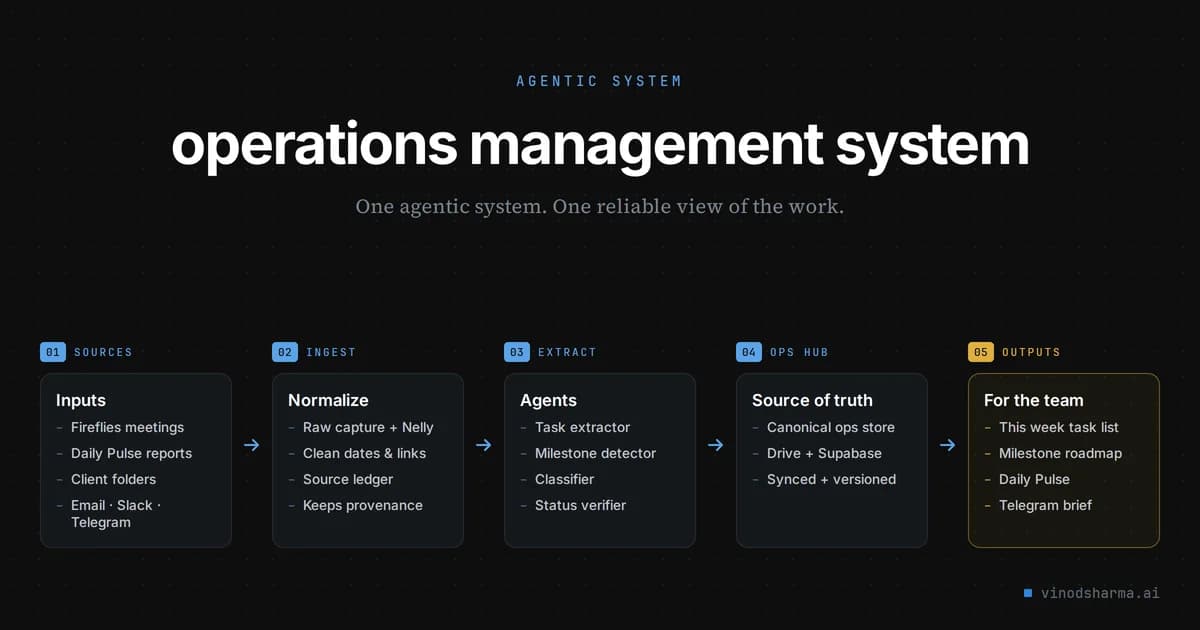
It is an Operations Management System. The OMS.
It pulls from everywhere. Rough notes I write in the middle of the night. Meeting transcripts from Fireflies. Slack conversations across multiple workspaces. Telegram voice and text updates. Campaign data from Meta Ads and Google Ads. Newsletter data from Kit and Omnisend. Market trend signals from X, Reddit, Google.
All of that goes in.
What comes out is one reliable view.
The wiki for every project. The tasks for every workstream. The daily pulse showing what moved. The milestones. The next actions. The project status. The knowledge base that captures the why behind every decision.
It is available on demand. I can ask it anything. I can also let it push daily updates through the channels we already use. Telegram in the morning. Slack at noon. An email summary at night if I want one.
The OMS does not replace the team. It replaces the part of the team that nobody wanted to do anyway. The collecting. The transcribing. The status updates. The "wait, what did we say about that?" loop.
That part is now a system.
Why it works now and did not before
I want to be clear about something. I did not get more disciplined.
I am 52. I have three kids. I have a full-time job as a Senior Manager at AdventHealth. I am building Sucana at 4am every morning. There is no version of me with more hours in the day or more focus to spare.
The reason the second brain works now is that the system does the boring parts.
The collecting. The organizing. The distilling. The cross-linking. The "where did we put that" search. The "what did Virgil decide on Tuesday" recall. All of it.
I do the thinking. I do the deciding. I do the building. The system does the rest.
That was the missing piece in 2021 when I first tried this. The framework was right. The tools were not enough. You still had to be the human in the middle, every day, pulling threads from one tool and tying them into another. That is the part that breaks.
Claude Code and Hermes-Agent close that gap.
What this looks like in a normal day
I wake up at 4am. I sit down with coffee.
I open Telegram. There is a morning brief waiting. What happened yesterday across the business. What is on my plate today. Anything that flagged itself as needing attention.
I do not open six tools to construct that picture. The OMS already did.
At 7am I leave for the day job. While I am at AdventHealth, the systems keep running. New transcripts come in. They get extracted. Decisions get logged. Tasks get assigned. The brain updates itself.
At 9pm I come back to the desk for an hour. I read what the systems wrote. I correct what they got wrong. I add what they could not have known. The next morning's brief is already getting better.
That is the loop. The brain feeds itself. I feed the brain. Neither of us has to do it alone.
What I would tell someone starting from here
If you are building a business right now and your knowledge, tasks, meetings, and updates are scattered across too many tools, you already have the inputs. You have meetings happening, Slack threads piling up, a CRM somewhere, a Google Drive with 4,000 files in it. The information is there.
You do not have a tool problem.
You have a connection problem.
The missing piece is a system that quietly connects the messy inputs, works alongside your team, and stays up to date without anyone touching it. That is the unlock. Once you have it, the second brain idea finally makes sense. Until you have it, the framework is just a clean diagram on top of a messy life.
This is the first time in my life it has felt sustainable.
Not because I became a different person.
Because the boring parts are no longer mine to carry.
If you are experimenting with AI agents, second brains, or a personal OS, I would love to compare notes. The patterns I am finding are not in any book yet. The tools are too new for any book to be written.
What I can tell you is what is currently working at 4am.