"Turn this into a STAR-format story I can use in a performance review or promotion conversation. Keep it concise, specific, and first-person. Situation, Task, Action, Result."
Here's what that raw note becomes:
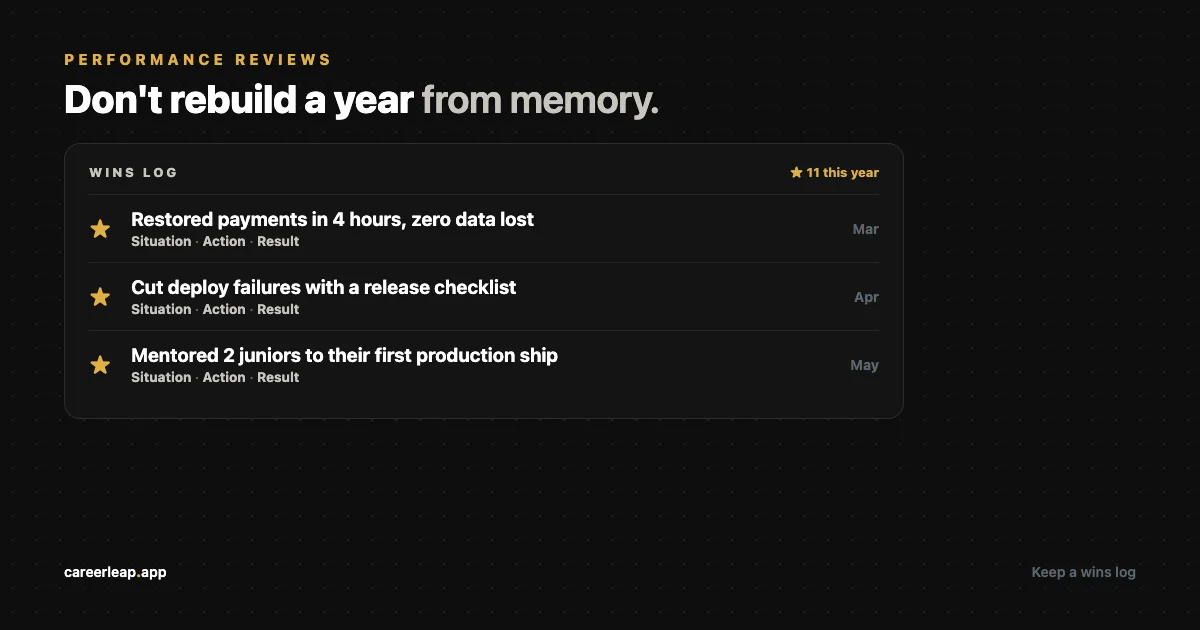
Situation: A misconfigured deployment caused payment failures for approximately 20% of active users during peak hours.
Task: Identify the root cause quickly and restore service without data loss.
Action: I traced the failure to a rate-limiting conflict introduced by a Friday config push, rolled back the change, implemented retry logic with exponential backoff, and coordinated a clean deployment by midday.
Result: Full payment functionality restored within 4 hours. Zero transactions lost. I also documented the incident and proposed a deployment checklist to prevent similar misses.
That's a promotion conversation. Written in under 10 minutes of actual effort.
Step 4: Review it and save it somewhere searchable
Spend 60 seconds reading the AI output. Fix anything that sounds off or doesn't reflect what actually happened. AI will sometimes soften your language or miss a nuance. You want it to sound like you, not a resume writer.
Then save it somewhere you'll actually find it. A Notion database, a Google Doc titled "Wins Log", a folder in your notes app. The format matters less than the habit. What you're building is a searchable library of your own impact.
Aim for one story per week. After a month, you'll have more material for your next review than most people collect in a year.
If you would rather not rely on remembering, that is exactly what the Agentic Brain Kit automates: you tell it what you shipped, and it keeps the running record for you, then turns it into a resume when you need one. But even a plain notes file beats zero.
Step 5: Use it when it counts
This is where the system pays off.
In performance reviews, pull 3-5 stories that map to your company's values or leveling criteria. In promotion conversations, lead with results and let the situation provide context. In 1:1s with your manager, share a recent story as a casual update. You're not bragging. You're giving your manager the language to advocate for you when you're not in the room.
Most engineers wait until review season to reconstruct 12 months of work from memory. You'll have a curated library ready to go.
Back to that annual review
A few months after that painful meeting, I started doing this. Not perfectly, not every single week. But consistently enough that by my next review, I walked in with 11 stories. Real ones, specific ones, with results I could point to.
My manager said it was the most prepared anyone on the team had ever been.
You're already doing the hard work. The career part just needs 10 minutes and a notes app.
What's one problem you solved this week that you haven't documented yet?